
Psalm 151 | Pusillus eram inter fratres
“If, weak as you are, you yet are chosen for some position of authority among the brethren, you must not be puffed up as though you were superior to them, but rather glorify the Lord Who chose you, and sing Psalm 151, which is especially the Psalm of David.”
Crossway’s ESV with Apocrypha printed by Anglican House Press for the use of the Anglican Church in North America contains an expanded Apocrypha which exceeds even the books listed in the 39 Articles of Religion. If you were to open it up and take a look toward the back of the volume, you would find the 151st Psalm provided. This is an apocryphal canticle which is attributed to King David and has its roots in the Second Temple Period. It later finds retentions in the Septuagint and Armenian Scriptures. The ESV with Apocrypha renders the text as follows:
1. I was small among my brothers and youngest in my father’s house; *
I tended my father’s sheep.
2. My hands made a harp, *
my fingers fashioned a lyre.
3. And who will declare it to my Lord? *
The Lord himself; he himself listens.
4. It was he who sent his messenger and took me from my father’s sheep *
and anointed me with his anointing oil.
5. My brothers were handsome and tall, *
but the Lord was not satisfied with them.
6. I went out to meet the Philistine,*
and he cursed me by his idols.
7 But I drew his own sword; *
I beheaded him and removed reproach from the children of Israel.
So what are we to do with this? As it stands, there is a lovely canticle in our Bibles that we do not utilize whatsoever. Unfortunately, within the Western Tradition, there is almost no utilization of Psalm 151 apart a passing usage in the breviary. Supplementing this slim Western usage are the considerably more robust uses in the Eastern Communions. Together, these may provide a handful of possibilities for resourcing this canticle already present within our Anglican Bibles. I posit the following two uses:
In the Sarum Breviary, Psalm 151 was used along with the Historia Regum readings, that is, the lections from the books of Kings following Trinity Sunday. This is because the canticle is a paraphrase of the narrative of King David. Unsurprisingly, then, it is especially fitting for kings. This kingly association may color any future uses in Anglican parishes. For instance, it may be a fitting canticle to sing during the Liturgy for Christ the King Sunday.
In the Coptic Tradition, the canticle is utilized during the Vigil of Holy Saturday (called the “Bright Saturday Vigil” or “Apocalypse Vigil”). This is appropriate considering how Goliath’s defeat at the hand of minuscule David is a fitting analogy for the harrowing of hell: the weak and slain Christ overcomes all the might of Hades. The Holy Saturday liturgy makes for a fitting use in the Anglican context as well.
In both cases, the Gospel Procession seems to me to be the best placement for the canticle. We have utilized the following setting quite successfully for both occasions in my parish. It is provided here as a resource to others who may want to experiment with doing likewise:
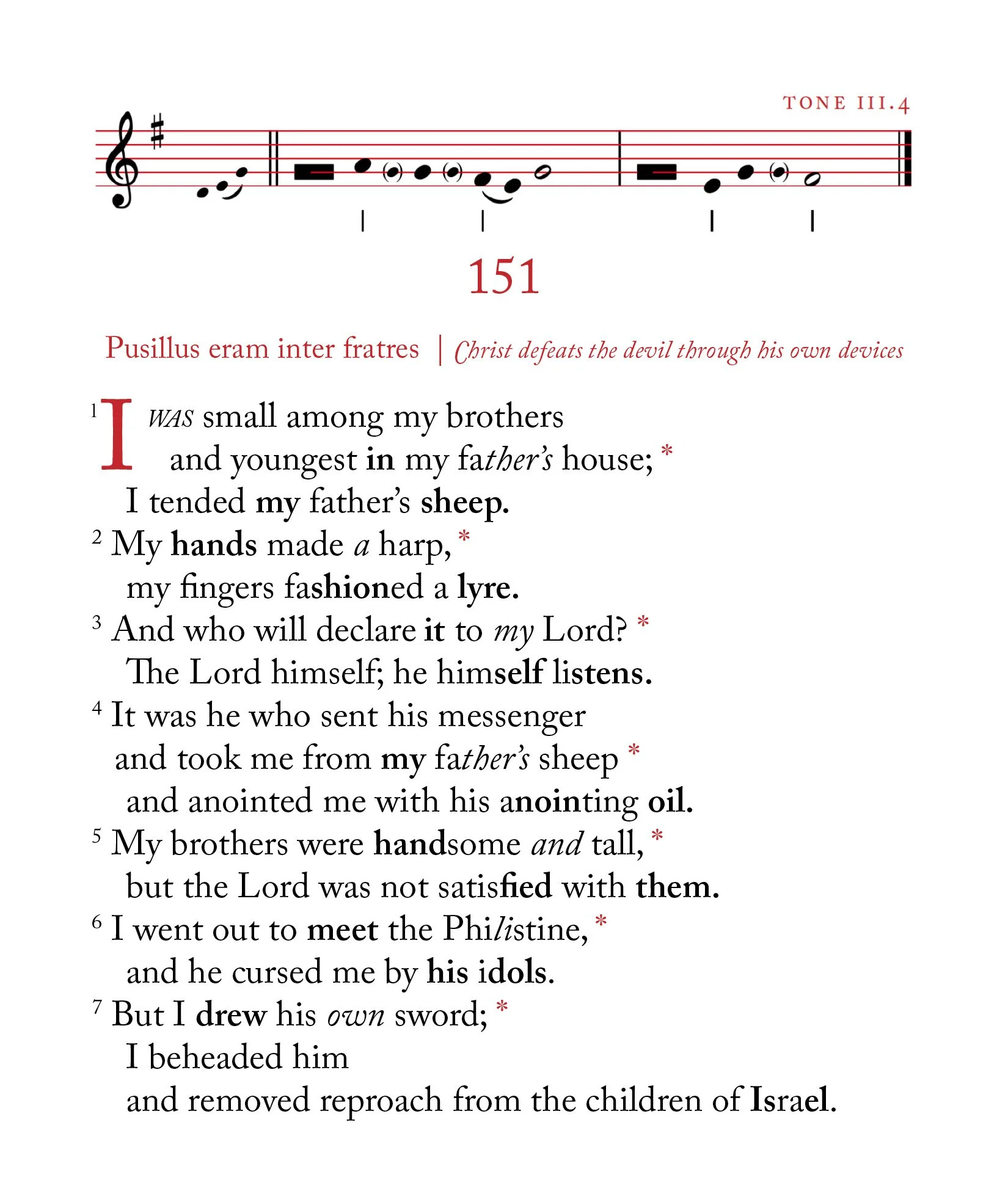
Psalm 151 Pointed.
The following is Psalm 151 set to Tone III.4 in the style of the St. Bernard’s Breviary, utilizing the text of Crossway’s ESV with Apocrypha published by Anglican House Press for the use of the Anglican Church in North America.
Scripture quotations are from the ESV® Bible (The Holy Bible, English Standard Version®), © 2001 by Crossway, a publishing ministry of Good News Publishers. ESV Text Edition: 2025. The ESV text may not be quoted in any publication made available to the public by a Creative Commons license. The ESV may not be translated in whole or in part into any other language. Used by permission. All rights reserved.
